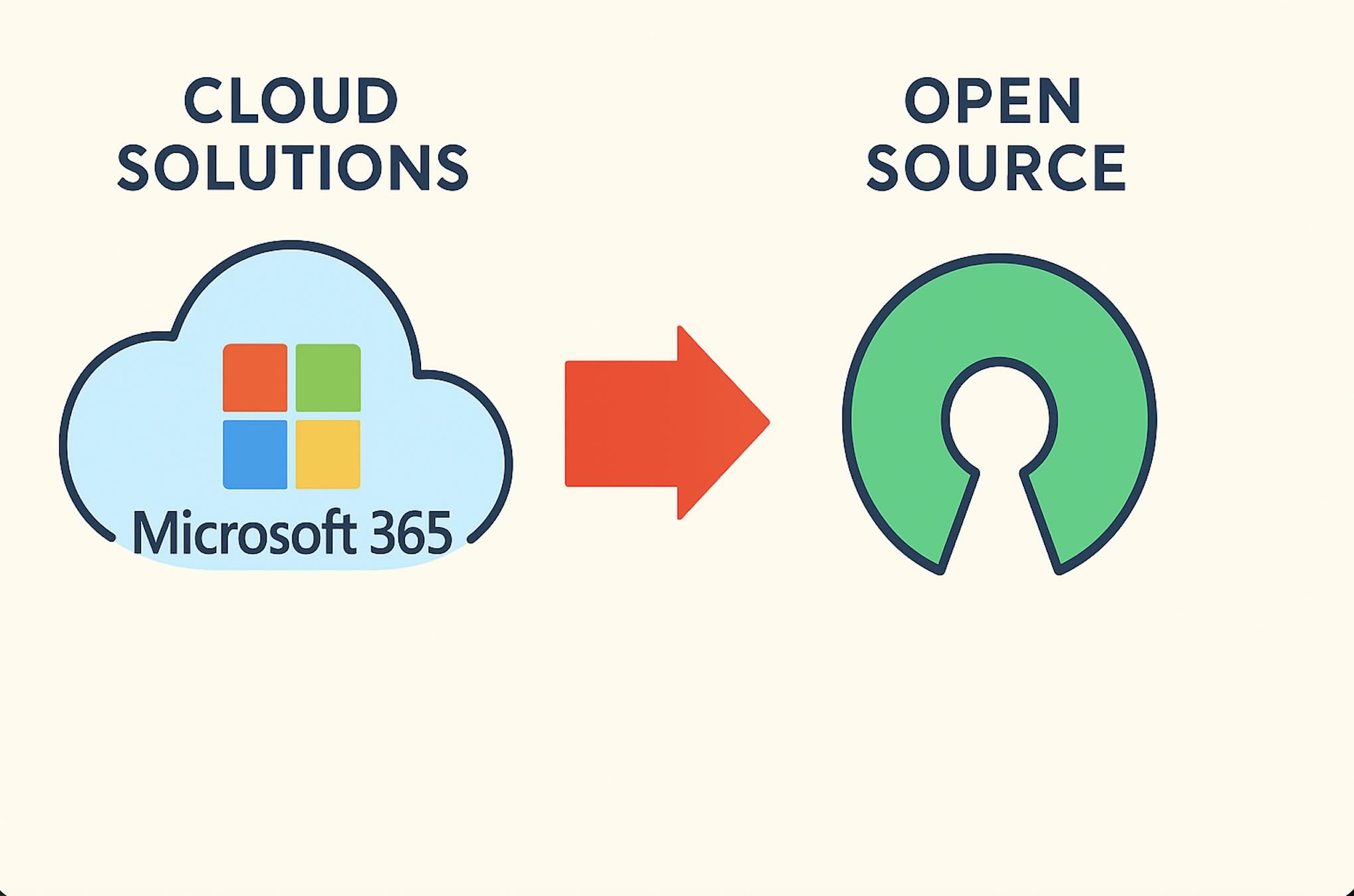
Turning Away from Microsoft 365 and Public Clouds
In 2025, public and private organizations across Europe are increasingly choosing to migrate away from Microsoft 365. The need for control over sensitive data and stronger compliance with European regulations, and the desire to avoid costly vendor lock-in are driving this movement.
While hosting Microsoft 365 on-premises or in private clouds is one option, another, more radical alternative is to turn completely away from proprietary platforms and embracing open source alternatives.
Why Organizations Are Migrating
The reasons behind this shift are not superficial. They reflect deep concerns about dependency and sovereignty:
- Reliance on U.S.-based services exposes organizations to sanctions or political instability.
- Vendor lock-in: Microsoft’s recent price hikes (~40%) highlight the lack of control customers have over costs.
- Data protection: U.S. laws such as the Cloud Act allow American authorities to access data stored by U.S. companies, even if it is stored abroad.
Notable Examples Across Europe
Several governments are leading the way:
- The Danish federal government is moving away from Microsoft software, citing national data control.
- Schleswig-Holstein in Germany is pioneering digital independence, with civil servants, police officers and judges set to abandon Microsoft programmes.
These migrations are part of a broader push for digital sovereignty — ensuring that Europe’s future is not dictated by big tech companies. - Switzerland is setting a strong example by asserting control over citizen information.
Open Source as the Alternative
The solution can be independent with locally hosted open-source stacks:
- Resilience since it is not dependent on one vendor. The community or the organization can continue development.
- Flexibility with open-source licenses that allow modification, redistribution, and integration with other systems.
- Future-proofing as there is independence from proprietary roadmaps and pricing.
Open source is not monolithic and success depends on multiple factors:
- The health of the community supporting the project.
- The pace of development and the complexity of the stack.
- Strategic initiatives such as EuroStack (https://eurostack.eu/) and smaller cloud providers such as A1 Telekom (https://www.a1.net/business) or Timewarp (https://timewarp.at/) provide an alternative to public cloud players.
Among German states, Schleswig-Holstein stands out as a pioneer in Germany with its open source strategy explicitly aims to create a counter-offer to proprietary software.
Switzerland has made a U-turn and is abandoning public clouds
In 2025, Switzerland’s data protection authorities set an example by asserting control over citizen information and recommending broad restrictions on the use of US clouds, such as AWS, Google and Microsoft, for federal agencies. This effectively bans the use of services such as Microsoft 365 as full SaaS platforms whenever sensitive or legally protected data is involved. The authorities cited risks from inadequate encryption, opaque subcontractor chains, and the extraterritorial reach of the U.S. Cloud Act as reasons for this decision.
While not legally binding, this stance highlights a broader European strategy, demonstrating how national regulators can challenge global providers and prompt governments to reconsider IT strategies in favour of more sovereign solutions.