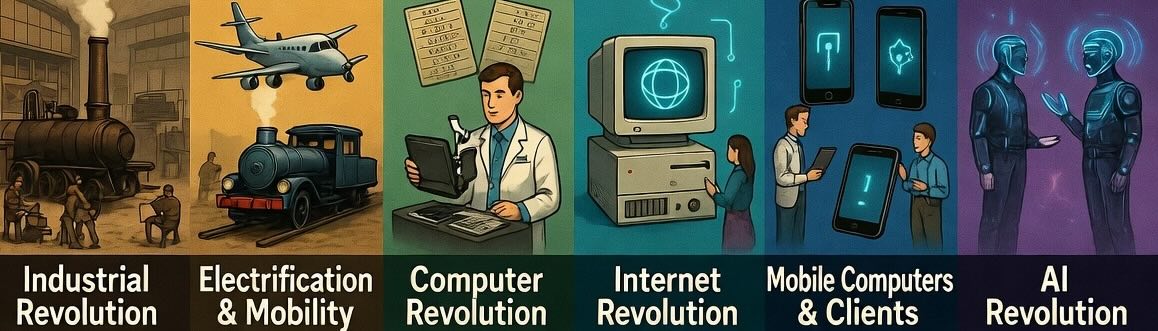
Will AI Agents Replace Human Labor - One of the hottest speculated topics today
Time for a fact check instead of speculation!
A measured 0.66% annual increase in productivity over 10 years.
20% estimated as a productivity boost; actually did -19%.
…
Let us look at the empirical and some publications…
A hammer never took a carpenter’s job - it changed what carpentry paid for. The real question about AI agents is not “human or machine” but which tasks move, and what about demand and productivity?
Will AI cost jobs in IT?
It reduces to one equation: Labor needed = Output ÷ Productivity.
Higher productivity with fixed output and headcount. When the output rises enough, headcount grows anyway. Which case wins is the Jevons paradox (1865, The Coal Question) - cheaper-to-use resources can raise total demand. It is empirical and so the parameters are dynamic and move:
- Acemoglu, The Simple Macroeconomics of AI (2025): realistic AI contribution to total factor productivity is ≤0.66% over 10 years (~0.07%/yr) - an order of magnitude under the 7% hype, and possibly overstated.
- WEF Future of Jobs 2025: by 2030, 92M roles displaced, 170M created, net +78M (~22% churn). Routine clerical/cognitive roles shrink; developers and AI/data specialists are among the fastest-growing.
- METR RCT (2025): experienced devs were 19% slower with early-2025 AI while believing they were 20% faster. Productivity gains are real but neither automatic nor uniform.
Furthermore, displacement is concentrated (juniors, routine tasks). The risk is inequality and uneven distribution.
Bullshit jobs will be wiped away since they can be automated with sophisticated tools, especially AI.
The NVIDIA Computex 2026 contradiction
The NVIDIA 2026 keynote made four claims that do not fit together: (1) AI makes developers ~3x more productive; (2) the 88-core Vera CPU is built for agents, not humans; (3) programmers must use enough AI tokens to support their work; (4) AI won’t replace humans. Claims 1-3 describe a workforce needing fewer people per unit of output. Then claim 4 survives only if demand expands (Jevons). Claim 4 was not supported by any means.
My Hypothesis
High-judgment, high-accountability work stays human, such as building clouds and systems; capital allocation; control, governance, and compliance; running the business and bearing liability.** These are context-dependent tasks with no single reward - exactly what Acemoglu flags as hard to automate. However, AI becomes pervasive tooling beneath them: drafting, scaffolding, refactoring, monitoring.
The future is rather engineers operating fleets of agents. And jobs will include policy definition, specifying, controlling, and verifying the actions and interactions of bots.
AI is a task-automation layer, while labor will still be necessary. The economics will move between apocalypse and hype. Humans keep the system, the capital, and accountability within a more complex network, alongside personal AI and an increasing number of bots.
References
keynote *Keynote video: https://www.youtube.com/watch?v=wSp6AiNIrsY *Keynote video cut: https://www.youtube.com/watch?v=O8jg-Shxd3o